Large cruise ships from major lines like Carnival, Royal Caribbean, Holland America, Princess, and Norwegian are engineered to withstand extreme seas - but the honest answer to this question is that modern cruise lines do everything possible to make sure it's never put to the test.
What Is Your Favorite Type Of Cruise Excursion?
Cruise ships are built to handle serious storms - but the real story is what happens before a hurricane ever gets close. Cruise line weather teams, dedicated meteorologists, and captains with real-time satellite data all work together to route ships away from danger days before conditions deteriorate. Here's what that actually means for your vacation:
- Itinerary changes are the first tool, not the last resort. When a storm develops, cruise lines begin rerouting ships two to five days out - long before seas turn rough. Most passengers experience this as a port swap or a schedule shift, not a weather event.
- Royal Caribbean was the first cruise line to hire a dedicated chief meteorologist, a role created after the Anthem of the Seas encountered rough weather in 2016. Today, Royal Caribbean Group's chief meteorologist Craig Setzer maintains direct contact with captains and bridge teams across the Royal Caribbean, Celebrity, and Silversea fleets around the clock.
- Ships track storms using the same satellite and buoy data as NOAA - and corporate operations centers layer that data across entire fleets, so the decision to move a ship isn't made by one captain alone but by a team that can see the full picture.
- Pacific Mexico hurricane season peaks from late August through October, which aligns closely with when West Coast ships return from Alaska and begin Mexican Riviera itineraries. Cruise lines have been factoring this into deployment planning as year-round Mexico sailings from Los Angeles and San Diego have expanded.
- If your port gets skipped due to weather, shore excursion refunds are standard. If you booked through the cruise line, the refund is automatic. Travel insurance and a good advisor - Heather at Flow Voyages can help you think through coverage before you book - are your backstops for anything beyond port fees.
What Would It Take for a Cruise Ship to Sink in a Hurricane?
The short answer is: far more than most people assume. Naval architects design large ocean-going cruise ships to withstand waves up to 15 meters (about 50 feet) from trough to crest - that's the standard structural threshold per international maritime design guidelines. In a storm with significant wave heights of 12 meters, a 15-meter wave is statistically the worst-case scenario under normal ocean conditions.
That said, hurricanes don't produce normal ocean conditions. When Hurricane Ivan tore through the Gulf of Mexico in September 2004 as a Category 4 storm with peak winds of 165 mph, Naval Research Laboratory instruments recorded individual waves reaching 91 feet (27.7 meters) near the eyewall - at the time the largest waves ever scientifically measured in a hurricane. Those measurements came from seafloor sensors that survived precisely because they weren't floating on the surface.
The important qualifier: wave heights like that are concentrated in a hurricane's eyewall - a relatively small area of the storm. Outside that zone, wind and wave intensity drop off significantly. A large cruise ship with functioning engines and navigation will steer well away from the worst parts of the storm and certainly avoid the eyewall. It's possible sometimes for cruise ships to travel through the outer bands of a storm without catastrophic structural risk but cruise lines are really really good at forcasting bad weather and have decades of practice with contingency planning.

Promoted by FlowAds

Whether a Ship Can Survive Is the Wrong Question
A cruise ship that loses engine power in a storm is a fundamentally different problem than one that keeps moving. The Viking Sky incident in March 2019 made this clear: she suffered engine failure off the Norwegian coast in 26-foot seas and began rolling heavily while adrift. She didn't sink - modern hull design and stability gave her plenty of margin - but the situation required a dramatic helicopter rescue of 479 passengers before power was restored.
The lesson isn't about structural limits. It's about operational ones. A ship that can steer can face waves bow-first, avoid the worst quadrants of a storm, and move through or away from danger. A ship that's adrift becomes a cork.
That's why cruise lines invest so heavily in what happens before a storm, not during one.
The Engineering Behind the Stability Numbers
Modern cruise ships look top-heavy. Stacked 15 to 20 decks high, they seem like they'd tip at the first serious roll. The physics works differently. The heaviest components - engines, fuel, ballast tanks, provisions - sit at the very bottom of the hull, well below the waterline. The upper decks are comparatively light: open spaces, furniture, and passengers. This weight distribution keeps the center of gravity low even when the superstructure is tall.
Marine tests confirm that large cruise ships can roll to nearly 60 degrees before reaching the point where they won't right themselves. For context, a 20-degree roll is enough to make walking difficult. A 60-degree roll would be catastrophic for everyone aboard - but structurally, the ship would still recover. Active fin stabilizers, which work similarly to airplane ailerons, reduce rolling in heavy seas. Ballast tanks can be adjusted in real time to compensate for uneven loads. Dynamic positioning systems help maintain heading without full manual control.
The result is a vessel that's significantly more stable than it appears - and significantly more capable of handling rough seas than most passengers would expect.
Hurricanes on the West Coast - Pacific Mexico Is Not the Caribbean
Most discussions about cruises and hurricanes focus on the Caribbean and Atlantic coast. For CruiseWestCoast readers, the more relevant picture is the Eastern Pacific.
The Eastern Pacific hurricane season officially runs from May 15 to November 30, with peak activity in late August through early October, according to NOAA's 30-year climatological data. For Mexican Riviera ports - Puerto Vallarta in Jalisco, Mazatlán in Sinaloa, Cabo San Lucas at the tip of Baja - the highest-risk window falls squarely in September and October. That used to be less relevant because most West Coast ships spent those months finishing Alaska itineraries before repositioning south. Year-round Mexico sailings from Los Angeles and San Diego have changed that calculus.
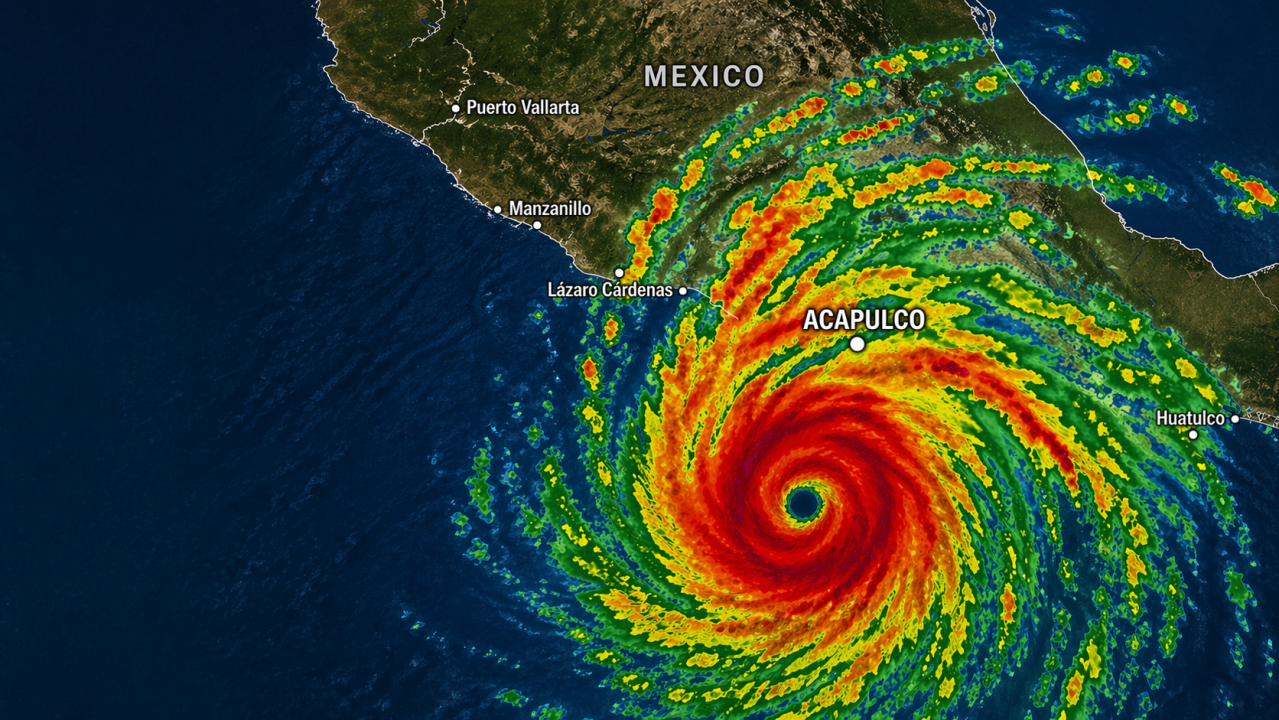
Hurricane Otis made the stakes concrete. In October 2023, Otis underwent one of the fastest intensifications ever recorded in the Eastern Pacific - going from a tropical storm to a Category 5 hurricane with 165 mph winds in less than 24 hours. It made landfall near Acapulco as the strongest hurricane ever recorded on Mexico's Pacific coast, causing an estimated $12-16 billion in damage and devastating the port city's tourism infrastructure. Forecasters had fewer than six hours to warn residents before landfall. The port is only now beginning a serious recovery, with Global Ports Holding taking a 24-year operating concession and Carnival Cruise Line planning a cautious return to Acapulco itineraries.
Otis didn't directly threaten cruise ships - they were routed away well before the storm developed into something dangerous. But it reset the conversation about what Eastern Pacific storms can do and how quickly they can intensify. Understanding how hurricanes form and move in Pacific Mexico - and what cruise lines do to track and avoid them - is worth knowing before you book a Mexican Riviera sailing in September.
That's also why typhoon season matters for anyone cruising Asia. The Western Pacific sees some of the most intense tropical cyclones on earth, classified as typhoons rather than hurricanes but identical in physics. Major cruise lines operating in Southeast Asian waters - including Japanese and Vietnamese itineraries - maintain the same kind of corporate weather monitoring infrastructure to reroute ships away from developing systems.
What Actually Happens When a Storm Threatens Your Itinerary
Royal Caribbean created the cruise industry's first dedicated chief meteorologist role in 2017, a position currently held by Craig Setzer - a veteran meteorologist with more than 30 years of experience. His job, and the jobs of equivalent teams at every major cruise line, is to watch developing weather systems around the clock and work with captains to route ships around them.
The practical result: cruise lines almost always know about a threatening storm days before it becomes a passenger-facing problem. Rerouting decisions typically happen 48-72 hours out. Passengers get notified of itinerary changes, alternative ports are substituted where possible, and shore excursion refunds for missed ports are processed automatically for anything booked through the cruise line.
Heather and I experienced this on a Caribbean sailing when a storm prompted a full itinerary reroute. The cruise line opened the ship's phones so passengers could call home, offered future cruise credit for missed ports, and repositioned us completely out of harm's way. Several guests were frustrated about the port changes. But nobody questioned whether the decision was right.
No itinerary change feels great in the moment. Watching a stop you've been looking forward to disappear from the screen is genuinely disappointing. The trade is always the same: miss a port, or put passengers in conditions that would be at best deeply unpleasant and at worst genuinely dangerous. Cruise lines make that call the same way every time.
Book Smart for Hurricane Season
If you're sailing on a Mexican Riviera cruise in September or October - or anywhere in the Caribbean between August and October - a few things are worth knowing before you go.
Travel insurance that covers itinerary changes is not the same as cancel-for-any-reason coverage. Standard travel insurance typically reimburses prepaid non-refundable expenses if a covered event forces a port skip, but won't pay out just because you're disappointed with a reroute. Knowing what your policy actually covers before you need it matters. Heather at Flow Voyages can walk you through what coverage makes sense for a specific sailing - the conversation is most useful at booking time, not departure day.
Future cruise credits issued for weather-related itinerary changes have expiration dates and ship restrictions that vary by line. Ask about the terms before you get home.
The Ship Will Be Fine. Plan Accordingly.
Modern large cruise ships are built to handle serious sea conditions, backed by meteorological teams that are watching the forecast before you've even thought to check it. The scenario where a major cruise ship sinks in a hurricane is not something that has happened to any passenger vessel in the modern fleet era - and the layers of engineering, monitoring, and routing decisions in place make it extraordinarily unlikely to change.
What will happen occasionally is that your itinerary changes. A port disappears, a new one appears in its place, or the ship spends an extra day at sea on an altered route. That's not a failure of the system - that's the system working exactly as designed.
The cruise lines aren't perfect forecasters and neither is anyone else. What Hurricane Otis demonstrated is that the Eastern Pacific can produce storms that outpace models, intensify faster than predicted, and demand decisions in compressed timeframes. The answer to that isn't to avoid sailing - it's to book smart, carry the right insurance, and trust that the people watching the radar do this professionally, every day.
If you're planning a Mexican Riviera cruise and want to talk through timing, itinerary risk, and what the current year's forecast patterns look like, Heather at Flow Voyages is the right call.
Thanks for reading. We hope this was helpful!
Why stop now?
Participate In Our Polls | Ask or Answer A Cruise Question | Contact Heather to Book Your Next Cruise!