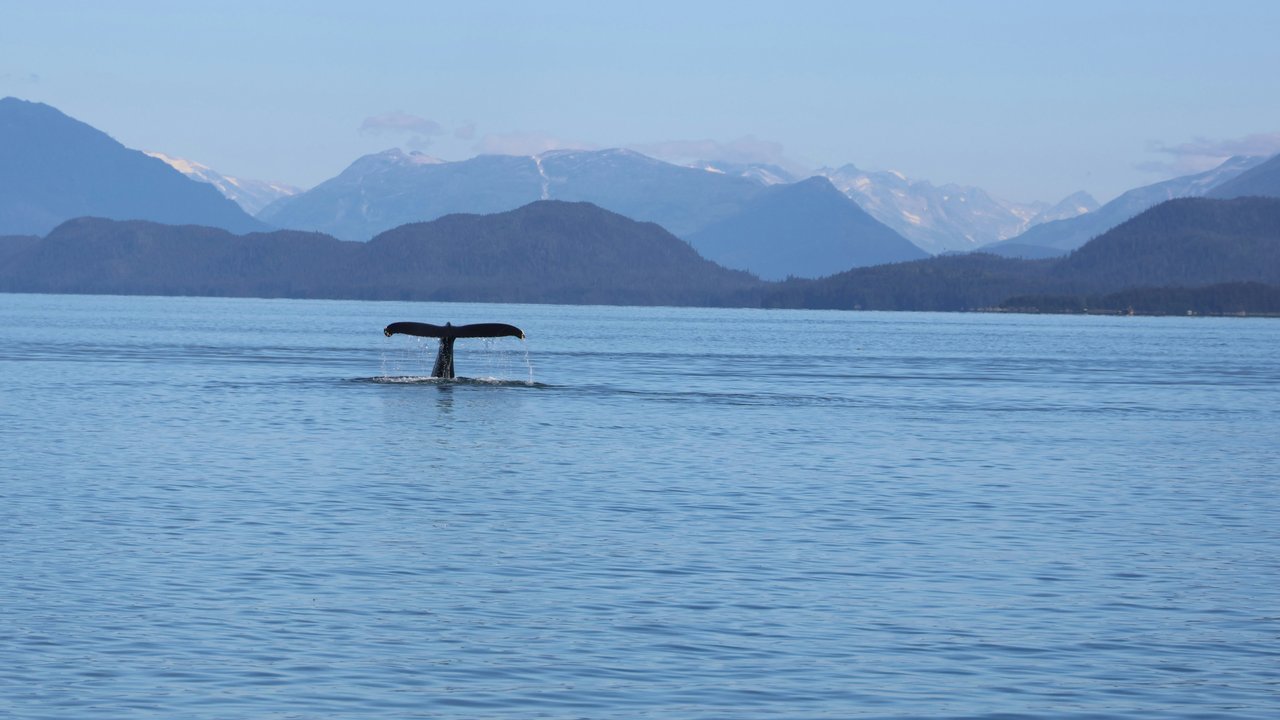
Whale strikes by large ships are an ongoing problem in Alaska's busiest cruise waters, and the latest reminder arrived in Sitka on September 17, when Norwegian Joy docked with a dead endangered fin whale across its bulbous bow. It was the second fin whale to reach an Alaska port on a cruise ship's bow this summer, and NOAA has not determined whether the ship killed it. As more ships and bigger ships sail these waters, encounters with whales will keep rising, and the cruise industry can do more than it does today to make them less deadly.
You have more influence over this than it seems from a balcony. These are the practical things a passenger can do before and during an Alaska sailing. We have written before about reducing our cruise footprint and the environmental tech the industry is adopting, and we should be writing about it more often. A whale on the bow of a cruise ship is exactly the kind of story that deserves a clear look at the facts, the history and the fixes, without pointing fingers before the investigation is done. Norwegian Joy was on day seven of a 10-night roundtrip from Seattle, sailing from Hoonah and Icy Strait Point to Sitka, when the whale was found on the bulbous bow, the rounded section that sits below the waterline at the front of the ship. NOAA describes it as a 57.5-foot adult male that was freshly dead. The ship held offshore while a tug removed the carcass and docked roughly two and a half hours late. The whale sank about 40 feet offshore while it was being towed toward a beach, and responders secured it with lines to trees on shore. NOAA Fisheries' Office of Law Enforcement is investigating, and the stranding network planned a necropsy as weather allowed. NOAA's spokesperson said it was too early to say whether the strike killed the whale or it was already dead. Reports differ on where along the route the contact happened, and no official source has published the ship's speed. Norwegian Cruise Line called it "a sobering reminder of the importance of ongoing collaboration among the maritime, scientific and conservation communities" and said it is cooperating with authorities. We will update this article when NOAA releases necropsy findings. NOAA's Lauren Wild told reporters, "We do not regularly see fin whales in Sitka Sound." Fin whales are the second-largest animals on Earth, listed as endangered, and NOAA currently names vessel strikes as the major threat to them. In June, Royal Caribbean's Ovation of the Seas docked in Seward, Alaska with a 61-foot pregnant fin whale on its bow. A preliminary necropsy found blunt-force trauma to the jaw, spine and ribs consistent with a vessel strike. The pattern goes back decades: A NOAA-affiliated study counted 108 reported whale-vessel collisions in Alaska between 1978 and 2011, 25 of them known to be fatal. Humpbacks made up 86 percent. More recently, KTOO reported nine vessel strike incidents around Juneau from 2020 to 2024, six of them involving calves. NOAA itself says the true number is higher because many strikes go unnoticed, happen far from anyone, or leave a carcass that sinks, which is nearly what happened to the Sitka whale. This is a question Heather's clients and our readers have asked us. How does an animal that communicates by sound miss a 1,000-foot ship? The answer is physics. Most of a ship's noise comes from its stern propellers, and the hull blocks much of that sound from traveling forward. Researchers call it the bow null effect, and it leaves a quiet zone directly in front of the ship. Near the surface, sound reflected off the water can cancel out sound arriving directly, a phenomenon called Lloyd's mirror effect, so a whale resting or breathing at the surface can hear surprisingly little. Researchers, including Edmund Gerstein, have documented both effects as reasons marine mammals struggle to locate approaching vessels. Behavior plays a part too. A whale that is feeding is focused on feeding, and NOAA-backed education programs point out that whales do not appear to treat ships as threats. A whale that does notice late has little time to react, because a ship at 15 knots covers more than 450 meters every minute. A ship does not have to be going fast to be dangerous either. A 2025 analysis of 201 documented strikes in U.S. waters found that for vessels longer than about 350 feet, the chance a strike on a large whale other than a humpback is fatal stays above 79 percent at any speed over 5 knots. At the size of a modern cruise ship, avoiding the whale matters far more than softening the blow. According to Cruise Lines International Association figures reported by Maritime Executive, Alaska's cruise passenger volume grew about 350 percent between 1995 and 2025, peaking near 1.7 million passengers in 2024. Sitka tells a smaller-scale story: about 383,000 cruise visitors in 2022, 560,000 in 2023, 590,000 in 2024, and nearly 630,000 projected for 2027, according to local station KCAW. The private dock that opened there can berth two ships of about 1,150 feet at once. Whales have been increasing in some of the same waters. The National Park Service counted 55 cruise ship entries into Glacier Bay in 1970 and 224 in 2009, while humpbacks using the area grew to more than 150 over the same period. As traffic grows and ships get bigger, the sad reality is that whale strikes will increase unless something changes. That does not excuse anyone. It means we should all be asking cruise lines and maritime leaders to push harder on solutions. Bridge teams in Southeast Alaska are not starting from zero. The Whale Alert network, adopted by NOAA and Glacier Bay National Park in 2016, lets cruise ships, marine pilots, state ferries and the Coast Guard share whale sightings in near real time. Crews can then post extra lookouts, slow down or change course. In 2022 the network logged 927 reports, and Norwegian Encore topped every ship with 280 of them. Local marine pilots slow to about 10 knots in areas with whales, compared with a typical cruising speed of around 15 knots. Glacier Bay enforces 13-knot and 10-knot limits in designated whale waters, and in July 2026 the park imposed an emergency 13-knot limit in the lower bay as humpbacks crowded in. Training is growing. A new class built by Glacier Bay whale biologists and the Southeast Alaska Pilots' Association began in August 2026 at the University of Alaska Southeast in Ketchikan, using ship simulators and bridge-team role play. MSC Cruises carried a dedicated marine mammal observer from the nonprofit ORCA on MSC Poesia this summer, working from the bridge with binoculars and video. The limits are real, and they explain why lookouts alone are not enough. A 2019 study of cruise ships in Alaska found a surfacing humpback gives the bridge about three chances to spot it, roughly 20 seconds apart. A ship at 19 knots has to start turning at least 1,121 meters out to keep 100 meters of clearance from a whale, compared with about 741 meters at 10 knots. Slowing a large cruise ship from 22 to about 15 knots can take 25 minutes and 7 nautical miles, which is why speed changes have to be planned for known whale areas rather than made in the moment. Whale-detecting buoys do exist. In California's Santa Barbara Channel, the Whale Safe system uses a moored buoy with a hydrophone, an onboard computer that identifies the calls of blue, humpback, and fin whales, and a satellite link that reports detections in near real time. Whale Safe combines those detections with sightings and habitat models into a daily whale presence rating for ships, and it publicly grades shipping companies on whether they slow down. Cameras are the newer tool. In May 2026, the UC Santa Barbara team behind Whale Safe installed thermal cameras on Angel Island in San Francisco Bay that can pick up the heat of a whale's blow up to 4 nautical miles away, day or night, with AI flagging detections for experts to confirm before alerts go out. Commercial systems built on the same idea are starting to go onboard cargo ships. Speed programs have results to show. California's Blue Whales Blue Skies program had 787 vessels travel more than 481,000 nautical miles at 10 knots or less in its 2025 season, and program estimates put the strike mortality risk from those transits about 58 percent lower. Passenger ships became eligible to participate in 2026. On the East Coast, a federal rule has required vessels 65 feet and longer to slow to 10 knots in seasonal right whale areas since 2008. Closer to Alaska's departure ports, Vancouver's ECHO program and Washington's Quiet Sound ask ships, including cruise ships, to slow to 14.5 knots when endangered orcas are nearby, mainly to cut underwater noise. Vancouver reported 85 percent participation in 2025. We could not find a real-time whale alert system like Whale Safe covering Southeast Alaska's cruise routes, and outside Glacier Bay there is no mandatory speed limit for large ships. A 2023 petition asking for a national strategy to reduce whale strikes has not produced federal action. None of this requires inventing something new. The tools exist, and Alaska is a place where the cruise lines have the scale and the money to lead: For more on how ship speed shapes the cruise experience, we covered cruise ship speed in detail. Slower sailing is often more comfortable and burns less fuel, so it is an easier change to sell to passengers than it sounds. What happened near Sitka is tragic, and so was the whale in Seward in June. Even so, I do not think these strikes are a reason to talk about banning cruise ships from Alaska. Bringing people to Alaska to watch a humpback surface from their balcony, or to stand on a whale watching boat out of Juneau, is how people come to care about whales enough to demand better. If you are sailing to Alaska, pick your whale watching timing, bring binoculars, and when you get home, check whether your cruise line shows up in the Blue Whales Blue Skies rankings now that passenger ships can take part. None of this is about blaming one cruise line. But if we are going to keep running this much commercial traffic through such a critically important marine habitat, speed limits in known whale feeding areas and real-time monitoring like hydrophone buoys need to be put in place in Alaska.What Is Your Favorite Type Of Cruise Excursion?
What We Know About The Sitka Fin Whale
Alaska Has Seen This Before
Why A Whale Does Not Hear A Cruise Ship Coming And Can't Get Out Of The Way
More Ships, Bigger Ships, More Encounters
What Captains And Pilots Can Do Today
Listening Buoys And Heat-Sensing Cameras
What The Cruise Industry Can Do Next
Seeing Whales Is What Builds The Demand For Change