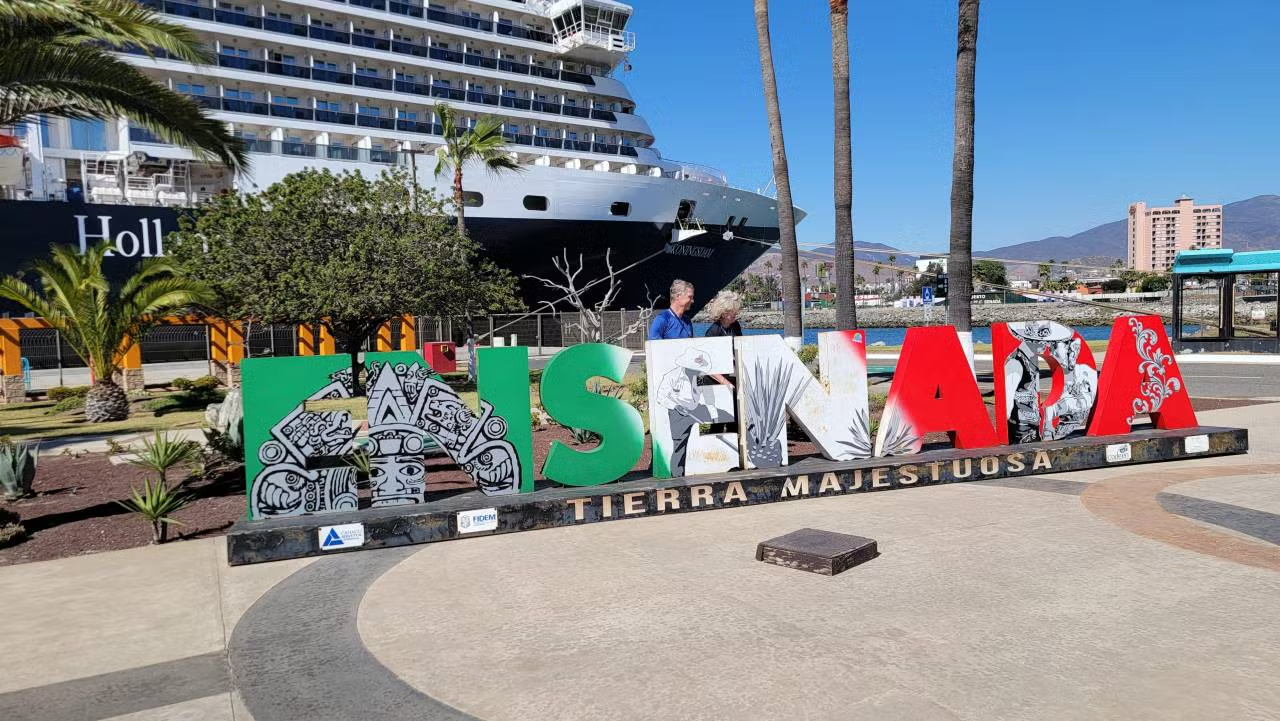
Nearly every cruise itinerary on the U.S. West Coast is shaped by a single outdated law: the Passenger Vessel Services Act of 1886. It is the reason Alaska cruises out of Seattle stop in Canada, why California coastal sailings detour to Ensenada, and why Hawaii itineraries either stretch into long round-trips or include stops that feel geographically out of place.
Originally written to protect a domestic shipbuilding industry, the law now operates in a very different reality - one where roughly 90 percent of cruise ships sail under foreign flags and the industry it was meant to protect barely exists in its original form. The result is a rule that dictates where ships can go, how itineraries are designed, and in some cases, what kind of cruise experience you end up having.
The short version of why your West Coast itinerary looks the way it does:
- The PVSA of 1886 requires foreign-flagged ships - about 90 percent of the global cruise fleet per CLIA - to call at a foreign port between U.S. destinations. The penalty is $996 per passenger.
- "Nearby" foreign ports like Victoria, Vancouver, Prince Rupert, and Ensenada satisfy the rule for closed-loop sailings (start and end at the same U.S. port). "Distant" foreign ports in South America or the ABC Islands allow one-way itineraries.
- Carnival's $26 million Ensenada Bay Village, announced December 5, 2025, is the first real attempt in two decades to upgrade the Ensenada port experience. Construction runs about 24 months; opening is targeted for late 2027 or early 2028.
- The U.S.-flagged small-ship fleet is shrinking. These are the only ships that can sail Alaska-only itineraries today, and in 2026 Alaskan Dream Cruises shut down while Lindblad's two U.S.-flag Alaska ships began their farewell season.
- Private yacht charters fall under the same law. A foreign-built boat can legally carry up to 12 paying passengers only inside the route its federal waiver covers, so ask to see the waiver before you book an Alaska charter.
What the PVSA Actually Does
At its core, the law is simple. A foreign-flagged cruise ship cannot carry passengers between two U.S. ports without first calling at a foreign port. The penalty for getting it wrong is currently $996 per passenger - a number that scales fast on a 3,000-passenger ship. Cruise lines simply design itineraries to avoid the risk entirely.
That requirement might sound like a technicality, but it drives almost every routing decision you see on the West Coast. It is why cruises that look like they should be straightforward - San Diego to San Francisco, Seattle to Alaska, Los Angeles to Hawaii - end up including stops that do not always make sense from a traveler's perspective. (For the related story of why almost no cruise captains on West Coast itineraries are American despite the U.S. ports involved, see how someone becomes a cruise ship captain.)
The Detail That Drives Itineraries
Where the law gets more disruptive is in how it defines foreign ports.
Stops in Canada, Mexico, and most of the Caribbean are considered "nearby" foreign ports. Cruises that only visit nearby ports must begin and end in the same U.S. city. That is why a Hawaii sailing from San Diego has to return to San Diego rather than drop passengers off in Honolulu.
To run a one-way itinerary between U.S. ports, a ship needs to include what the law considers a "distant" foreign port - in practice, South America or the ABC Islands (Aruba, Bonaire, Curaçao). The most absurd consequence: cruise lines have at times built stops at Fanning Island in the Republic of Kiribati - 1,000 miles south of Hawaii - into Hawaii sailings, just to satisfy the distant-foreign-port rule and run a non-closed-loop itinerary.
How It Plays Out in Real Cruises
Once you know what to look for, the pattern becomes obvious.
On Alaska cruises out of Seattle, the required foreign stop usually means a call in Canada. Vancouver works well as an embarkation point, and Prince Rupert - now used by Virgin Voyages and a handful of other operators - has become a more interesting alternative because it keeps the ship closer to Alaska. Victoria, on the other hand, often feels like a checkbox. An evening stop that satisfies the law more than it enhances the trip.
California coastal cruises feel the constraint even more. The mandatory stop in Ensenada limits how far north those itineraries can realistically go. Routes that could otherwise reach Astoria or spend more time along the Northern California coast get compressed to make room for a stop that many repeat cruisers have already experienced multiple times.
Hawaii is where the restrictions become most obvious. Large cruise ships cannot freely move between the islands unless they are U.S.-flagged, which is why Norwegian's Pride of America stands almost alone in that market. Other options either involve long round-trip sailings from the mainland or itineraries built around compliance rather than convenience.
A Rare Shift: Ensenada May Finally Improve
For years, one of the frustrations with PVSA-driven itineraries has been that required ports do not always have strong incentives to evolve. When ships have to stop somewhere regardless of quality, improvement can lag.
That is why the December 2025 announcement of Ensenada Bay Village is worth watching. Backed by Carnival Corporation in partnership with ITM Group and Hutchison Ports ECV, the $26 million project aims to upgrade the port experience with new dining venues, cultural attractions, an adventure park, a beach club, and a spa. Construction is expected to take about 24 months, with an opening targeted for late 2027 or early 2028. If it delivers on its promise, it could turn what has long felt like a mandatory stop into something travelers look forward to. Notably, this is Carnival's first tourism-development project outside the Caribbean.
The Exception That Proves the Rule
There is a version of West Coast cruising that operates without these constraints. It is just not the one most travelers are booking.
A small group of U.S.-flagged ships can run Alaska-only and Hawaii-only itineraries because they fall outside PVSA restrictions. UnCruise Adventures runs seven small ships in Alaska, from the 22-guest Safari Quest to the 86-guest Wilderness Legacy, and its 36-guest Safari Explorer also sails Hawaii. Lindblad Expeditions / National Geographic runs the 62-passenger Sea Bird and Sea Lion through the Inside Passage, but 2026 is their farewell season. Their replacement, the 154-passenger Greg Mortimer, is registered in the Bahamas, so Lindblad's Alaska sailings from 2027 will include stops in Canada - the PVSA now shapes the expedition itinerary too. American Cruise Lines and The Boat Company round out the U.S.-flag options in Alaska.
Alaskan Dream Cruises, a Sitka-based line whose four ships carried 40 to 80 guests each, ceased operations on February 4, 2026 and cancelled more than 100 sailings planned for the season. Two names that still turn up on older lists of U.S.-flag lines are also gone: Blount Small Ship Adventures shut down in 2020 and American Queen Voyages in 2024.
These ships are smaller, more expensive, and built around a different kind of experience. But they show what becomes possible when the regulatory constraints are removed.
2026: The PVSA Reaches Alaska Yachts and Small Expedition Ships
For most of its history, the PVSA debate has centered on large cruise ships and the ports they have to visit. In 2026 the pressure moved to the smallest passenger boats in Southeast Alaska. Dan Blanchard, CEO of UnCruise Adventures, kept bringing this up with me before I understood what was at stake.
The operators on the U.S. side sum up the requirement for carrying passengers between U.S. ports with no foreign stop as U.S.-built, U.S.-flagged, and U.S.-crewed. Legally, the boat has to be built and owned in the U.S. and documented for coastwise trade, and separate rules require a U.S. crew. There is one narrow exception. A foreign-built boat carrying no more than 12 paying passengers can apply to the U.S. Maritime Administration (MARAD) for a small-vessel waiver, and if it is approved, it can operate within the limits written into that waiver. Many private yacht charters in Southeast Alaska run legally this way.
On August 20, 2026, law enforcement officers from the Coast Guard Cutter Pike boarded a foreign-built charter yacht near Sitka and found it carrying passengers outside the geographic area its MARAD waiver allowed. The Coast Guard terminated the voyage and escorted the yacht back to Sitka Harbor. Alaska Public Media later identified the boat as the Bear Paw, built in British Columbia, whose waiver covered a route from Friday Harbor, Washington to Ketchikan. Its owners said they had been transparent with federal authorities and would do whatever the Coast Guard requires.
The operators who built or bought American say Sitka was one boat out of many. A coalition of U.S.-flag owners has documented 26 suspected illegal foreign vessels in Southeast Alaska, and Blanchard puts the count of foreign-flag charter operators between the Inside Passage and Yakutat at more than 30. The owners of the Dauntless, a 92-foot U.S.-built yacht out of Petersburg, passed on a Canadian-built boat that cost about a third as much because it could not legally carry their guests.
They say they lost three peak weeks of 2026 bookings to cheaper boats. Blanchard also points out that only a handful of people are tasked with enforcing the law across a region nearly the size of Florida.
For small-ship travelers, the two stories meet in the same place. The U.S.-flag fleet that can sail Juneau-to-Juneau with no Canadian stop lost Alaskan Dream this year, Lindblad's U.S.-flag ships are retiring, and the operators who remain say lower-cost foreign boats are eroding the market underneath them.
Why It Has Not Changed - and Why That May Be Shifting
Given how much the PVSA shapes modern cruising, it is fair to ask why it has not been updated. The answer is that the law is supported by a coalition that has been hard to break: maritime labor unions, national-security advocates, and the U.S.-flag operators who benefit from the current structure. Even as the industry around it has evolved, that coalition has been enough to stall meaningful reform.
That said, 2025 was the most active reform year in recent memory. In July 2025, Senator Mike Lee of Utah introduced three pieces of legislation under the banner of "America First Deregulation for Coastal Trade": the Open America's Ports Act (S.2537), which would repeal the PVSA outright; the Protecting Jobs in American Ports Act, which would remove the U.S.-built requirement; and the Safeguarding American Tourism Act, which would exempt large passenger vessels with 800 or more berths.
Senator Lisa Murkowski of Alaska continues to push for a permanent Alaska-specific exemption, building on the temporary Alaska Tourism Restoration Act she co-sponsored in 2021. As of September 2026, none of these have passed, and the structural opposition remains. The Southeast Alaska dispute shows the other side of that coalition: small U.S.-flag operators who paid more to build and crew American boats, and who see the PVSA as the protection their business model depends on.
What Reform Could Look Like for West Coast Cruisers
The most exciting possibility is one I would put real money on if it ever became reality: cruises that depart from Juneau and stay entirely in Alaska. On a current Alaska cruise out of Seattle, the first and last days are spent in transit between Seattle and southeast Alaska, eating into your seven-day vacation. A Juneau-to-Juneau sailing would let passengers spend all seven days in Alaska - more glacier time, more port days in Sitka, Petersburg, Wrangell, Haines, Skagway. The fly-in logistics are real, but the cruise itself becomes a meaningfully better Alaska experience.
The same logic would open San Francisco and Portland as more active home ports, allow Astoria-inclusive Cal Coastal sailings, and finally bring real competition to Hawaii cruising.
What It Means for Your Next Cruise
For now, the practical reality is unchanged. Alaska cruises will include a Canadian stop. California coastal sailings will continue to call in Ensenada. Hawaii itineraries will remain limited unless you are willing to look at smaller ships or longer routes. The Ensenada Bay Village development should make the Ensenada stop more interesting starting in late 2027 or 2028. Reform legislation may move, but on a timeline measured in years, not months.
If you are looking at a private yacht charter in Southeast Alaska instead, ask the operator three questions before you pay a deposit: where the boat was built, what flag it flies, and, if it was built outside the U.S., whether its MARAD waiver covers the route you are booking. Every small-vessel waiver request is published in the Federal Register for public comment, so a legitimate operator can point you to the notice for their boat. A charter sailing outside its waiver can be stopped by the Coast Guard mid-trip, which is exactly what happened near Sitka.
Understanding the PVSA does not change those options - but it does explain them. Once you see how much of your itinerary is shaped by a 19th-century law, it becomes a lot easier to choose the cruise that fits the experience you are looking for.
Ready to plan a West Coast cruise that makes the most of the itinerary the PVSA gives you - or to explore the small-ship options that do not have to follow it? Heather Hills at Flow Voyages can help you book a cruise tailored to Alaska, the Mexican Riviera, the California Coast, or Hawaii, including the U.S.-flag operators most travelers do not know exist.
Thanks for reading. We hope this was helpful!
Why stop now?
Participate In Our Polls | Ask or Answer A Cruise Question | Contact Heather to Book Your Next Cruise!